
Alex Quinn
- Formerly Assistant Professor at PurduePurdue University :: ECEElectrical & Computer Engineering (8/2014-5/2024)
- Contact: alexander.j.quinn@gmail.com
- Curriculum VitaeCV
|
|
Alex Quinn
|
| Advanced C Programming | Spring 2024, Spring 2023, Fall 2022, Spring 2022, Spring 2021, Spring 2020, Spring 2019, Fall 2017, Fall 2016, Fall 2015, Fall 2014 |
| Crowd-Powered Systems | Spring 2017, Spring 2015 |
| Data Structures | Fall 2023 |
| Human-Computer Interaction | Spring 2016, Spring 2018 |
| Software Engineering Tools | Fall 2018 |
My research spans several areas of human-computer interaction (HCI), including crowdsourcing, human computation, decision-making, digital libraries, and information visualization.
|
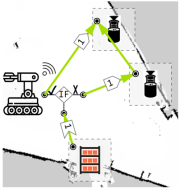
Labor transfer between humans, robots, and IoT devicesWe are developing technologies for efficient transfer of tasks and skills to factory workers, robots, and IoT devices. J. Shi, R. Jain, S. Chi, H. Doh, H. Chi, A. J. Quinn, K. Ramani. CARING-AI: Towards Authoring Context-aware Augmented Reality Instruction through Generative Artificial Intelligence. ACM CHI 2025. (Accepted; in press) MH Wu, A Ipsita, G Huang, K Ramani, A Quinn. ImpersonatAR: Using Embodied Authoring and Evaluation to Prototype Multi-Scenario Use Cases for Augmented Reality Applications. Journal of Computing and Information Science in Engineering (JCISE). 2024. A Ipsita, R Duan, H Li, S Chidambaram, Y Cao, M Liu, A Quinn, K Ramani. The design of a virtual prototyping system for authoring interactive virtual reality environments from real-world scans. Journal of Computing and Information Science in Engineering (JCISE). 2024. A Unmesh, R Jain, J Shi, VKC Manam, HG Chi, S Chidambaram, A Quinn, K. Ramani. Interacting objects: A dataset of object-object interactions for richer dynamic scene representations IEEE Robotics and Automation Letters. 2023. G. Huang, X. Qian, T. Wang, F. Patel, M. Sreeram, Y. Cao, K. Ramani, A. J. Quinn. AdapTutor: An Adaptive Tutoring System for Machine Tasks in Augmented Reality ACM CHI 2021. G. Huang, P. S. Rao, M. Wu, M. Wadhawan, S. Y. Nof, S. Chandrasegaran, K. Ramani, A. J. Quinn. Vipo: Spatial-Visual Programming with Functions for Robot-IoT Workflows. ACM CHI 2020. |
|
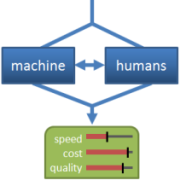
Crowdsourcing and Human ComputationMy primary research is about using human computation and crowdsourcing to tackle problems that are beyond the limits of artificial intelligence, information retrieval, natural language processing, and computer vision. V. K. C. Manam, J. Thomas, A. J. Quinn. TaskLint: Automated Detection of Ambiguities in Task Instructions. HCOMP 2022. G. Huang, M. Wu, A. J. Quinn. Task Design for Crowdsourcing Complex Cognitive Skills. ACM CHI 2021 Case Studies. A. Alshaibani, S. Carrell, L. Tseng, J. Shin, A. J. Quinn. Privacy-Preserving Face Redaction Using Crowdsourcing. HCOMP 2020. C. V. K. Manam & A. J. Quinn. WingIt: Efficient Refinement of Unclear Task Instructions. HCOMP 2018. M. Wu & A. J. Quinn. Confusing the crowd: Task instruction quality on Amazon Mechanical Turk. HCOMP 2017. A. Alshaibani, L. Tseng, S. Carrell, A. J. Quinn. IntoFocus: Privacy-preserving Crowd-powered Image Redaction. GroupSight Workshop @ HCOMP 2017. Best paper. G. Huang & A. J. Quinn. BlueSky: Crowd-Powered Uniform Sampling of Idea Spaces. Creativity & Cognition 2017. A. Kumavat, A. J. Quinn Show Me More! Worker-guided Privacy Filtering for Crowd Video Annotation. HCOMP GroupSight Workshop @ HCOMP 2016. A. J. Quinn & B. B. Bederson AskSheet: Efficient Human Computation for Decision Making with Spreadsheets. ACM CSCW 2014. P. Resnik, O. Buzek, Y. Kronrod, C. Hu, A. J. Quinn, B. B. Bederson Using Targeted Paraphrasing and Monolingual Crowdsourcing to Improve Translation. ACM TIST, June 2013. A. J. Quinn, B. B. Bederson Human Computation: A Survey and Taxonomy of a Growing Field. ACM CHI 2011. B. B. Bederson, A. J. Quinn Web Workers Unite! Addressing Challenges of Online Laborers. ACM CHI 2011 EA (alt.chi). A. J. Quinn, B. B. Bederson Human-Machine Hybrid Computation. ACM CHI 2011 Workshop on Crowdsourcing and Human Computation. P. Resnik, O. Buzek, C. Hu, Y. Kronrod, A. Quinn, & B. B. Bederson Improving Translation via Targeted Paraphrasing. ACL EMNLP 2010. A. J. Quinn, B. B. Bederson, T. Yeh, J. Lin CrowdFlow: Integrating Machine Learning with Mechanical Turk for Speed-Cost-Quality Flexibility. Tech. Report HCIL-2010-09, University of Maryland, 2010. [CrowdLib – Python library for Mechanical Turk] |
|
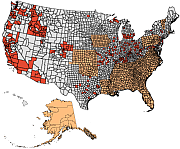
Restaurant Food Safety InspectionsWorking with a group of economists and computer scientists, I led development of a system to extract restaurant inspection reports from the web sites of health departments around the US. B. B. Bederson, G. Jin, P. Leslie, A. J. Quinn & B. Zou Incomplete Disclosure: Evidence of Signaling and Countersignaling. American Economic Journal: Microeconomics. 2016. In press. [Hazel Analytics, Inc. - company serving national chain restaurants] [InspectionRepo.com - search restaurant inspections] |

|
Table Interfaces for MuseumsWorking with MITH and the Smithsonian Institution, I developed two applications for the Microsoft Surface for viewing precious Asian artwork that would otherwise be difficult to see in entirety in the museum. The applications were deployed at the Sackler Gallery beginning in May 2011. Videos: |
|
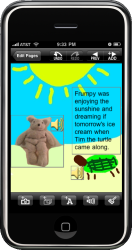
StoryKit: Designing with Children and Their EldersTogether with with a participatory design group composed of children and elder adults, we designed an iPhone application for creating and sharing stories composed of text, photos, sketches, and sounds. E. Bonsignore, A. J. Quinn, A. Druin, B. B. Bederson. Sharing stories “in the wild”: A mobile storytelling case study using StoryKit.. ACM ToCHI, July 2013. A. Druin, B. B. Bederson, A. J. Quinn. Designing Intergenerational Mobile Storytelling. IDC 2009, Workshop on Children and Mobile Technology. A. J. Quinn, B. B. Bederson, E. M. Bonsignore, A. Druin StoryKit: Designing a Mobile Application for Story Creation By Children And Older Adults. Tech. Report HCIL-2009-22, University of Maryland, 2009.
|
|
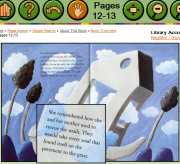
Readability in the International Children's Digital LibraryThe International Children's Digital Library (ICDL) is a collection of exemplary children's books from around the world, made freely available for reading on the web. Together with Prof. Ben Bederson, Dr. Chang Hu, Takeshi Arisaka, and Anne Rose, we developed methods for making the books easier to read on small screens, easier to translate into alternate languages, and easier to access for blind users. A. J. Quinn, C. Hu, T. Arisaka, A. Rose, & B. B. Bederson. Readability of scanned books in digital libraries. ACM CHI 2008. B. B. Bederson, A. J. Quinn, & A. Druin. Designing the Reading Experience for Scanned Multi-lingual Picture Books on Mobile Phones. ACM/IEEE JCDL 2009. |

|
Visualization of Temporal Data with Sentinal EventsThis project explored the idea of aligning temporal data by sentinal events. The work was further developed by Dr. Taowei Wang with Dr. Catherine Plaisant and Prof. Ben Shneiderman. T. D. Wang, C. Plaisant, A. J. Quinn, R. Stanchak, S. Murphy, B. Shneiderman Aligning temporal data by sentinel events: discovering patterns in electronic health records. ACM CHI 2008. |
|
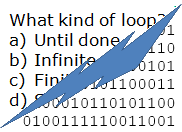
Interrogative ProgrammingWhat if, instead of learning a programming language, the computer could ask you a bunch of questions about what kind of program you want to make? Think of it like a consultant. I implemented this using a context-free grammar to guide a line of questioning. My user studies validated the idea on very simple tasks, but revealed some tough challenges for using this to build more useful programs. This was an undergraduate senior project advised by Prof. Steve Tanimoto at the University of Washington. A. Quinn An Interrogative Approach to Novice Programming. IEEE HCC 2002. |

|
CookieWatcher: Privacy Awareness in the BrowserDo users have any concept of the cookies being set in their web browsers? This Firefox extension lets you see cookies that are coming into your computer in real time so you can be more aware of how they are affecting your privacy. With this awareness, you can make more informed decisions about how to set your cookie preferences in your browser and which sites you might want to avoid algotether. This research project was part of a larger effort exploring informed consent online in collaboration with Prof. Batya Friedman and Dr. Dan Howe. Unfortunately, the extension is currently out of sync with the latest versions of Firefox, but it still has homes and screenshots at Mozdev and Mozilla.org. |